Architecture
This page provides a comprehensive view of the SIROS ID platform architecture, showing all major components and how they interact.
Platform Architecture Overview
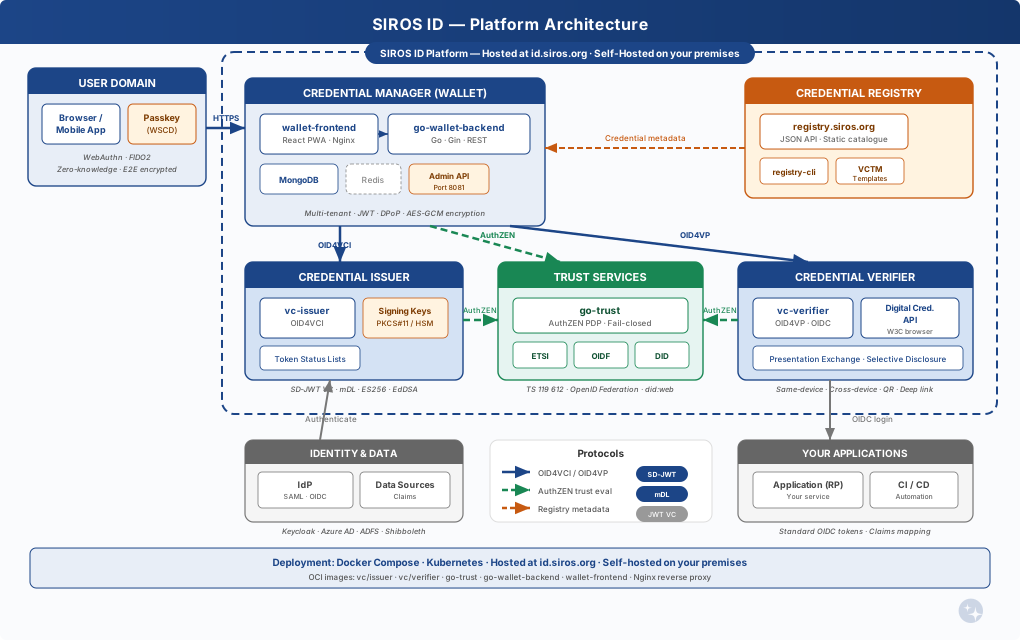
Click the diagram to open full-size in a new tab.
Component Summary
User Domain
The user interacts with SIROS ID through a browser or mobile app. Authentication is entirely passkey-based (FIDO2/WebAuthn) — there are no passwords. The passkey also functions as a Wallet Secure Cryptographic Device (WSCD), providing hardware-backed key storage and client-side credential encryption.
Credential Manager (Wallet)
The digital wallet consists of:
| Component | Technology | Role |
|---|---|---|
| wallet-frontend | React PWA, Nginx | User interface for managing credentials |
| go-wallet-backend | Go, Gin | API server, session management, encrypted storage |
| MongoDB | — | Persistent storage (all data encrypted at rest) |
| Redis | — | Optional caching layer |
| Admin API | Port 8081 | Tenant management (internal network only) |
The wallet is designed with a zero-knowledge architecture: the platform operator cannot identify users or read their credentials.
Credential Issuer
Built on SUNET/vc, the issuer creates and signs digital credentials using the OID4VCI protocol. It supports:
- SD-JWT VC and mDL/mDoc credential formats
- PKCS#11 HSM and QSCD for production signing keys
- Token Status Lists for credential revocation
- Pre-authorized and authorization code flows
Credential Verifier
Also built on SUNET/vc, the verifier validates credential presentations via OID4VP and acts as an OIDC Relying Party for downstream applications. It supports:
- Same-device and cross-device flows (QR codes, deep links)
- W3C Digital Credentials API for browser-native verification
- Selective disclosure and presentation exchange
Trust Services
go-trust is the Policy Decision Point (PDP) implementing the AuthZEN protocol. It evaluates trust by querying:
- ETSI Trust Lists (TS 119 612) — EU Trusted Service Providers
- OpenID Federation — Dynamic federation trust chains
- DID Resolution — did:web, did:webvh document resolution
The system operates in fail-closed mode: if the PDP is unreachable, all trust evaluations return negative.
Credential Registry
registry.siros.org aggregates Verifiable Credential Type Metadata (VCTM) from multiple organizations, providing:
- A static catalogue and JSON API for credential type discovery
- registry-cli for building and publishing metadata
- Cached metadata consumed by wallets and verifiers
Customer Infrastructure
Integrators connect their existing identity infrastructure:
- Identity Providers (SAML/OIDC/Keycloak) authenticate users for credential issuance
- Applications receive standard OIDC tokens after credential verification
- Data Sources supply claims and attributes for credential construction
Key Protocols
| Protocol | Purpose |
|---|---|
| OID4VCI | Credential issuance between issuer and wallet |
| OID4VP | Credential presentation from wallet to verifier |
| AuthZEN | Trust evaluation requests to the PDP |
| OIDC | Standard login flow from verifier to applications |
| WebAuthn | Passkey authentication and key derivation |
| DPoP | Demonstrating proof of possession for tokens |
Deployment
All components are available as OCI container images and can be deployed via Docker Compose or Kubernetes. A hosted instance is available at id.siros.org.
See Docker Images and Deployment Guides for details.